The Ground Beneath the Work
Place, contemplation, and the rhythm of Life Telling Processing
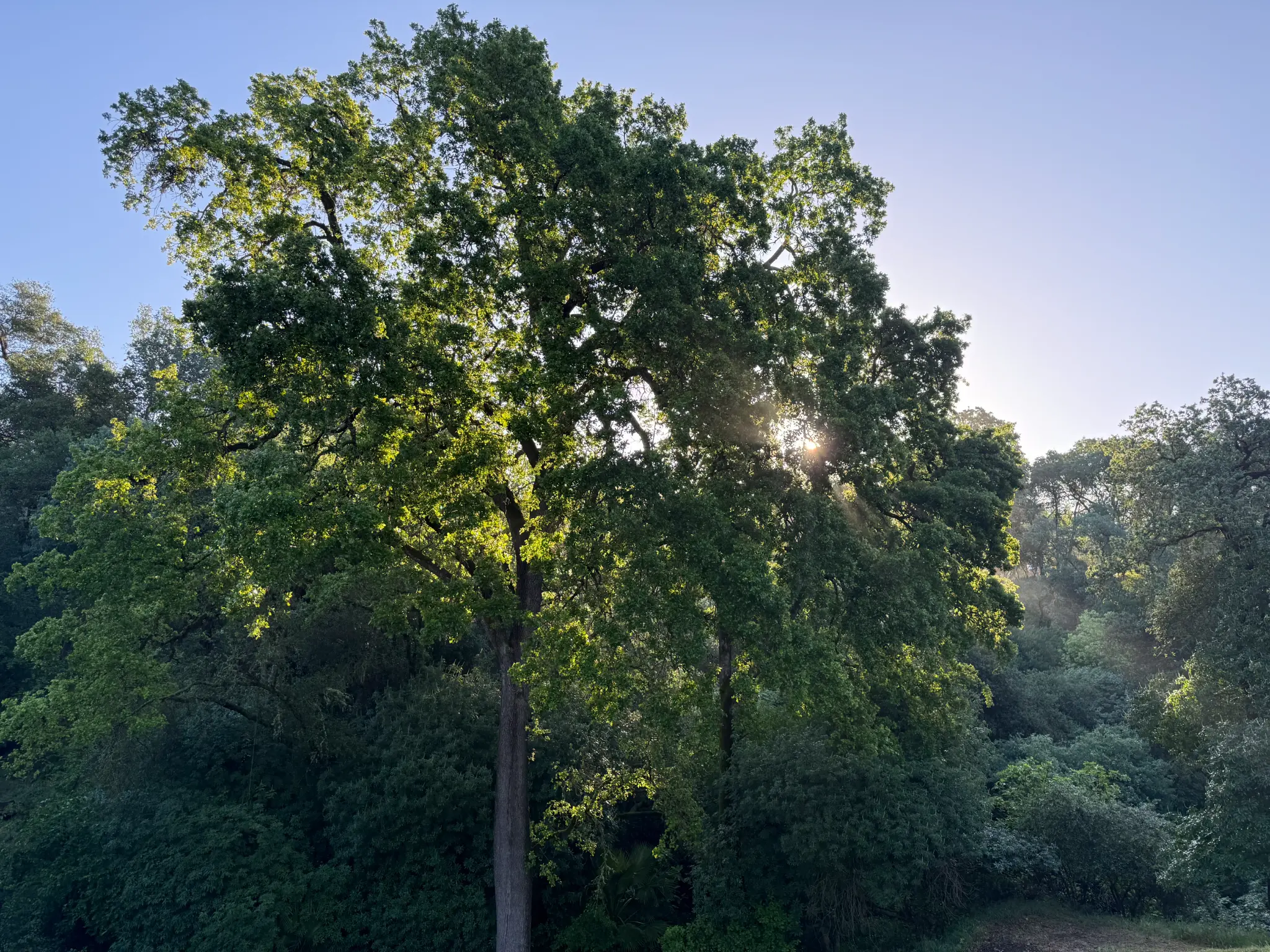
There is a particular quality of light in Fair Oaks in the early morning, the way it filters through the valley oaks before the heat of the day arrives, diffuse and unhurried, touching everything without insisting on anything. I have sat with that light many mornings before a session begins, and I have come to believe that it has taught me something about the kind of presence that Life Telling Processing requires.
I did not choose this place strategically. My wife and I came to our small retreat property at the base of the Sierra Nevada the way most significant things arrive, through a convergence of circumstance, longing, and what I can only describe as a kind of calling. But over the years, I have noticed that the land itself has become a teacher. Not in the sentimental way that phrase is sometimes used, but in the specific, embodied way that a place shapes the person who inhabits it, the way its rhythms become your rhythms, its silences become your silences, its patience becomes, slowly, your own.
What Place Does to a Therapist
There is a long tradition, in both contemplative spirituality and depth psychology, of recognizing that the outer landscape and the inner landscape are not as separate as we tend to assume. Thomas Merton wrote from his hermitage at Gethsemani about the way solitude and silence were not merely conditions for contemplation but active participants in it. The desert fathers and mothers of the early church understood that the landscape they chose, its harshness, its spaciousness, its refusal of distraction, was itself a kind of formation. The Celtic peregrini, those wandering pilgrims of the early Irish church, spoke of the thin places where the boundary between the visible and invisible world grows permeable.
I am not making a mystical claim about Fair Oaks. I am making a more modest and, I think, more honest one: that the place where a therapist does their interior work shapes the quality of presence they bring to the therapeutic relationship. And the quality of presence is, in the end, what the work of Life Telling Processing most requires.
The Sierra Nevada foothills are not dramatic in the way that the high mountains are dramatic. They are quieter than that, rolling, golden in summer, green in the brief wet season, threaded with creeks that run full in winter and slow to a murmur by July. There is a rhythm to this landscape that resists urgency. It does not reward rushing. It asks, instead, for a kind of attentive waiting, the willingness to be present to what is actually here, rather than anxious about what might come next.
This is precisely the quality that Life Telling Processing asks of me as a therapist, and that I try to offer to every person I work with.
The Contemplative Rhythm of Story Work
Life Telling Processing is, at its heart, a contemplative practice. Not in the sense that it requires religious belief or spiritual language, though for those for whom that language is alive, it is welcome here. But in the deeper sense that contemplation has always meant: the capacity to be present to what is, without immediately trying to fix, explain, or escape it.
When a client begins to tell their story, not the polished version they have rehearsed for years, but the actual story, with its contradictions and silences and unresolved chapters, what they need most from me is not analysis. It is witness. They need someone who can sit with the weight of the story without flinching, who can hold the broken pieces with care rather than rushing to reassemble them into something more comfortable.
This kind of witnessing is not passive. It is one of the most demanding things I know how to do. It requires the ability to be fully present, not thinking about the next question, not formulating an interpretation, not managing my own discomfort with the silence, but genuinely here, in this moment, with this person and this story.
The land at Fair Oaks has been a school for this. The oaks do not hurry. The creek does not apologize for its slowness. The light does not arrive on a schedule. And sitting with that unhurried presence, morning after morning, has shaped in me a capacity for the kind of attentive waiting that story work requires.
The Mosaic and the Landscape
The central metaphor of Life Telling Processing is the mosaic, the understanding that a human life is composed of fragments, some luminous and some dark, and that healing is not the elimination of the broken pieces but their integration into a picture that is whole and true.
I did not arrive at this metaphor through academic study alone. I arrived at it, in part, through watching the landscape of this place over years.
The Sierra Nevada foothills are themselves a kind of mosaic. The geology is ancient and complex: volcanic intrusions, river-carved canyons, granite outcroppings, the slow accumulation of alluvial soil in the valley floors. Nothing here is simple or uniform. The beauty of this landscape is not the beauty of a manicured garden. It is the beauty of things that have been broken and reshaped by time, by water, by heat and cold and the patient work of centuries. The valley oaks themselves are mosaics, their bark furrowed and irregular, their canopies asymmetrical, their roots reaching into soil that has been disturbed and restored many times over.
When I sit with a client's story, I am sitting with a landscape like this. Not a smooth, coherent narrative but a terrain that has been shaped by forces the person did not choose, early losses, relational fractures, the slow accumulation of survival strategies that once served brilliantly and now cost more than they give. The work is not to flatten this terrain into something easier to manage. The work is to learn its contours, to understand what shaped it, and to help the person who lives in it find the beauty that is already there, waiting to be seen.
Retreat as a Way of Working
My wife and I have spoken, over the years, about what it means to live on a retreat property, not as a destination for others, but as a way of inhabiting our own lives. A retreat is not an escape. It is a return. A return to what is essential, to what is slow enough to be noticed, to what has been present all along beneath the noise of the ordinary.
This is what I hope to offer in the therapeutic relationship as well. Not an escape from the complexity of a person's life, but a return to the story that has been there all along, waiting to be gathered and held and understood. A return to the self that exists beneath the performance, beneath the survival strategies, beneath the carefully managed image that high-achieving people learn to maintain.
The contemplative rhythm of this place has taught me that this kind of return cannot be forced. It can only be invited. The work of Life Telling Processing is, in the end, an invitation: to slow down enough to hear the deeper story, to be present to the fragments that have been waiting for attention, and to discover that the mosaic of your life, however broken it may feel, is already more whole than you know.
A Note on Virtual Work and Embodied Place
There is an apparent paradox in what I have written here. I practice entirely virtually, and every session takes place through a screen, across whatever distance separates my office in Fair Oaks from wherever my client is sitting. And yet I am writing about the formative power of a specific place.
I have come to believe that this paradox is less significant than it appears. What a therapist carries into the virtual room is not their physical location but their interior formation, the quality of presence, the capacity for attentive waiting, the willingness to be genuinely with another person in the difficulty of their story. These qualities are shaped by place, by practice, by the accumulated discipline of years. They travel.
The light through the valley oaks does not appear on my clients' screens. But something of what that light has formed in me, the patience, the unhurried attention, the willingness to sit with incompleteness and trust the process, does. That is what I mean when I say that this place has shaped the contemplative rhythm of this work in ways I could not have anticipated when I began it.
"The work of Life Telling Processing is, in the end, an invitation: to slow down enough to hear the deeper story, to be present to the fragments that have been waiting for attention, and to discover that the mosaic of your life, however broken it may feel, is already more whole than you know."
If something in this resonates, if you are drawn to the kind of slow, story-centered work that this describes, I would be honored to be your co-traveler.
Schedule a Free 15-Minute Consultation